Internal Rebellion: Inside OpenAI’s ‘Opportunistic’ Pentagon Deal and the Anthropic Fallout
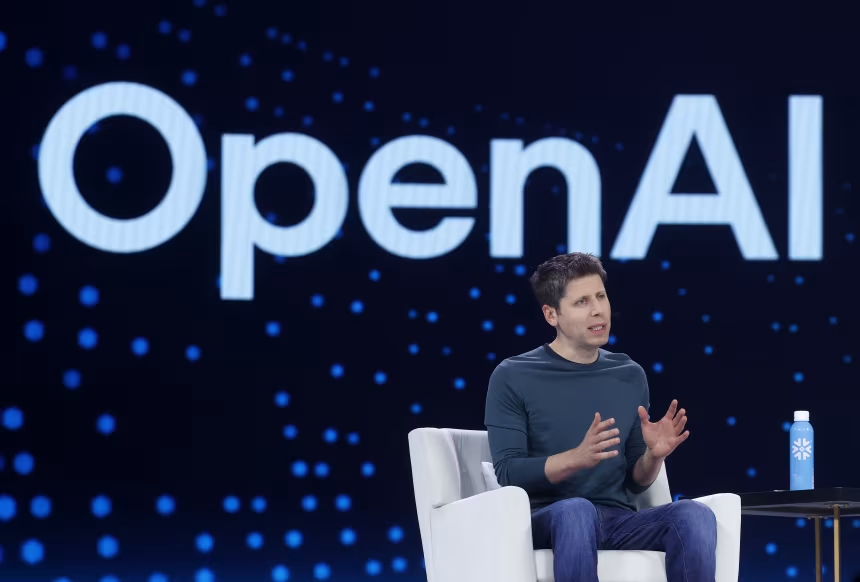
Edited by Technyfire Editor, Fortune Akinola
A deep internal rift is tearing through OpenAI following the company’s controversial decision to ink a classified systems contract with the Pentagon. What was intended as a strategic maneuver in the global AI arms race has instead sparked a firestorm of internal dissent, raising profound questions about the ethical redlines of artificial intelligence in military applications.
According to internal communications and employee accounts, the frustration isn’t solely about the military application of AI, but rather how OpenAI leadership—specifically CEO Sam Altman handled the negotiations in the shadow of its fiercest rival, Anthropic.
The Anthropic Precedent
The controversy began when Anthropic, a leading AI lab founded by former OpenAI executives, publicly rejected an updated contract with the Pentagon. Anthropic leadership cited a failure to reach an agreement on critical redlines regarding the use of its AI models in mass surveillance and autonomous weapons systems.
The Pentagon’s retaliation was swift: Anthropic was blacklisted and designated a “supply chain risk.”
Within the halls of OpenAI, Anthropic’s principled stand garnered significant, quiet respect. However, that respect quickly curdled into frustration as the deadline for Anthropic’s compliance ticked down. In a surprising public move, Sam Altman stated he shared Anthropic CEO Dario Amodei’s ethical redlines. Yet, behind closed doors, Altman was actively finalizing OpenAI’s own contract with the Department of Defense.
When OpenAI announced its deal seemingly swooping in to fill the void left by Anthropic’s refusal the optics were damaging.
‘Opportunistic and Sloppy’
The immediate aftermath saw public and private venting from OpenAI staff. When the company published heavily scrutinized excerpts of the contract, external observers and internal researchers alike questioned the efficacy of the safeguards. Critics argued the “weasel language” would still allow the Pentagon to bypass restrictions on autonomous weapons and surveillance.
Prominent voices within the company didn’t hold back. Research scientist Aidan McLaughlin posted his misgivings publicly, stating, “I personally don’t think this deal was worth it,” later describing the internal atmosphere as “overwhelming.” Jasmine Wang, an AI safety researcher at the firm, went as far as demanding “independent legal counsel” to parse the exact wording of the contract’s guardrails.
Altman was forced onto the defensive. Taking to X (formerly Twitter) to clarify that the contract explicitly prevents OpenAI services from being used in surveillance programs, he noticeably omitted any mention of autonomous weapons in his public update.
Facing an internal revolt, Altman addressed the company in an all-hands meeting, conceding that the rollout was deeply flawed.
“The issues are super complex, and demand clear communication,” Altman later admitted. “We were genuinely trying to de-escalate things and avoid a much worse outcome, but I think it just looked opportunistic and sloppy.” He maintained, however, that OpenAI cannot act as the arbiter for individual military use cases, determining which specific operations are “good or bad.”
The Geopolitical Reality
Despite the outrage, there is a pragmatic undercurrent among some OpenAI employees. Acknowledging the escalating AI competition between the United States and China, many staff members recognize the necessity of supporting domestic government infrastructure. The core grievance lies in the execution a deal of monumental magnitude that felt rushed, opaque, and poorly communicated to the people building the technology.
Furthermore, a faction within OpenAI has expressed frustration at the media’s portrayal of Anthropic as an untarnished hero, pointing to Anthropic’s previous years of defense work and partnerships with military contractors like Palantir that largely escaped public scrutiny.
In an attempt to mend fences, Altman told employees he is actively urging the government to drop Anthropic’s “supply chain risk” designation. His ultimate vision, he argued, is that the government must work with safety-conscious labs like OpenAI, even if their strict ethical guardrails “annoy” defense officials, rather than turning to vendors with fewer protections.
As the dust settles, one thing is clear: the bridge between Silicon Valley idealism and the realities of the military-industrial complex has never been more fragile.