Condom That Changes Color to Detect STIs. The Future of Safe Sex?
It sounds like a gadget ripped from a futuristic sci-fi novel: a condom that doesn’t just protect against pregnancy and STIs, but actively diagnoses them during the act, glowing a specific color to alert the user to the presence of an infection.
For years, the concept of a “smart condom” capable of detecting sexually transmitted infections (STIs) has captured the public imagination. It promises a revolutionary shift in sexual health—moving testing out of the clinic and into the bedroom, potentially curbing the global rise of infections like chlamydia and syphilis.
But is this color-changing prophylactic a viable future for safe sex, or a well-intentioned concept doomed by scientific and psychological hurdles?

The “S.T.EYE” Concept
The idea gained massive global traction around 2015 due to a brilliant concept developed by teenage students at the Isaac Newton Academy in London for the TeenTech awards.
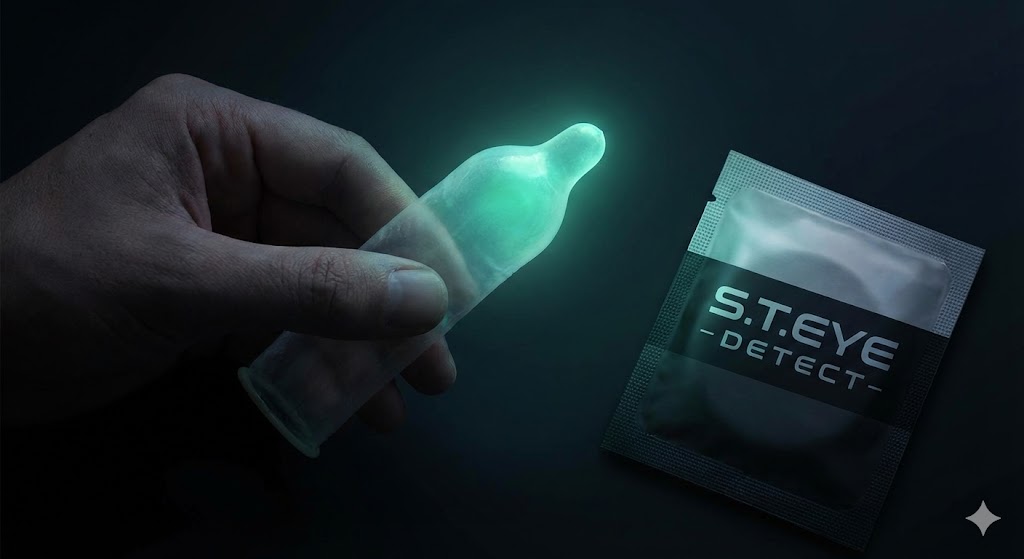
They dubbed their invention the “S.T.EYE.” The theoretical design proposed coating a condom with antibodies that would react with the bacteria or viruses found in common STIs. Upon contact with infected fluids during intercourse, the condom’s rubber would undergo a chemical reaction, causing a low-light fluorescence.
The proposed color-coding system was ingenious in its simplicity: glowing green for chlamydia, yellow for herpes, purple for human papillomavirus (HPV), and blue for syphilis.
“We wanted to create something that makes detecting harmful STIs safer than ever before, so that people can take immediate action in the privacy of their own homes without the invasive procedures at the doctors,” said Daanyaal Ali, one of the student inventors, at the time.
The concept went viral, praised for tackling the stigma surrounding STI testing and offering an immediate solution in the heat of the moment.
The Promise: Why We Need Innovation
The appeal of such a device is obvious from a public health perspective. The World Health Organization estimates that more than 1 million sexually transmitted infections are acquired every single day worldwide.
Many of these infections, particularly chlamydia and gonorrhea, are often asymptomatic (“silent”), meaning carriers unknowingly spread them. A device that makes the invisible visible could be a game-changer.
“The biggest barrier to STI control is lack of awareness,” says Dr. Aris Thorne, a public health researcher focusing on sexual wellness. “People are afraid of the clinic, they are embarrassed to ask partners for test results, or they simply don’t know they are infected. A point-of-care device that is integrated into the very act of sex addresses those barriers head-on.”
Advocates argue that if the technology worked, it would force immediate conversations between partners and prompt quicker medical treatment.
The Reality Check: Massive Hurdles Remain
Despite the viral fame of the S.T.EYE concept, nearly a decade later, you cannot buy a color-changing STI condom at the pharmacy. The journey from a brilliant classroom idea to a regulated medical device is fraught with immense challenges.
1. The Accuracy Dilemma
A diagnostic test requires extremely high sensitivity (not missing infections) and specificity (not flagging false alarms).
“Imagine the psychological impact of a ‘false positive’ in the middle of sexual intercourse,” notes Dr. Thorne. “If the condom glows yellow because of a pH imbalance or a reaction to a lubricant, rather than herpes, you have just created immense panic, ruined a relationship, and flooded clinics with terrified people who are actually healthy.”
Conversely, a false negative could give users a dangerous sense of security, leading them to skip regular clinic-based screenings.
2. The Regulatory Nightmare
A standard condom is classified as a medical device. A condom that also diagnoses disease is a “combination product.”
To bring this to market in the United States, for example, it would require rigorous FDA approval proving it is 99% effective as a contraceptive and highly accurate as a diagnostic tool across thousands of test subjects. The R&D costs for such a product would be astronomical.
3. The Behavioral Question
Sexual health educators worry about the real-world application. Would people actually use it? If a condom glows green, would the encounter stop immediately?
There is a fear that such a device could oversimplify complex health issues. An STI diagnosis requires medical intervention, counseling, and partner notification—things a glowing piece of latex cannot provide.
While the color-changing condom remains currently stuck in the “conceptual” phase, it has sparked a necessary evolution in sexual health technology.
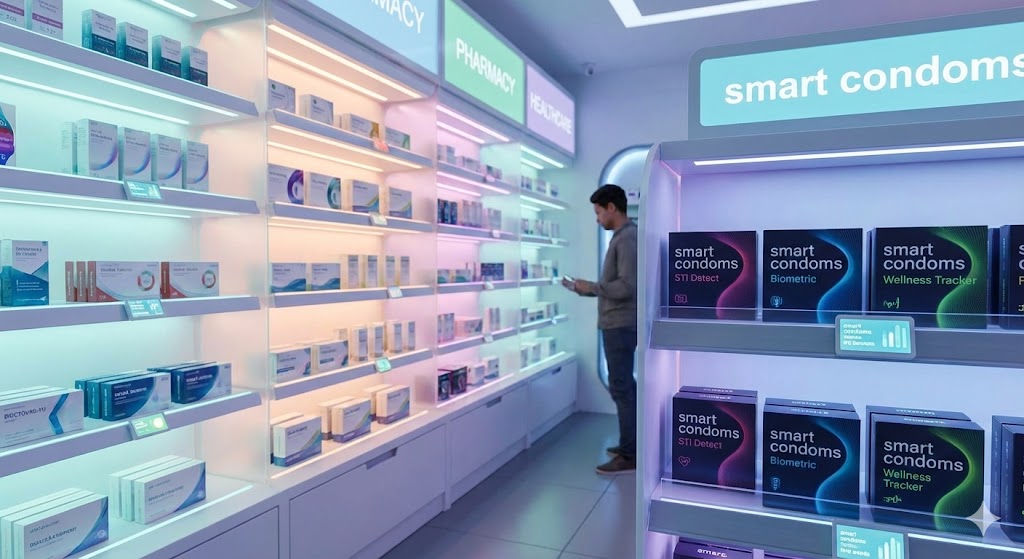
The current trend in “smart condoms” has pivoted slightly away from diagnostics and toward performance metrics—wearable tech for the penis that tracks speed, thrusts, and duration. However, the demand for at-home diagnostic tools is growing, evidenced by the rise of mail-in STI testing kits.
The “S.T.EYE” may never hit mass production in its original form. But as an idea, it successfully highlighted a desperate need: sexual health tools that are immediate, accessible, and de-stigmatized. The future of safe sex might not glow in the dark just yet, but the push for innovation is brighter than ever.